Showing posts with label side dish (Banchan). Show all posts

Wednesday, June 22, 2011

Tofu Stick Salad


The weather is finally becoming more like summer! I am already getting excited because we already have two camping trips and a few outdoor activities planned for coming months. In this kind of weather, a simple cold dish is just about what I need. When the weather turns hot, you really want to avoid any thing to do with the heat, be it your stove. Also you don't want to have left-overs sitting in your refrigerator for too long since the foods tends go bad more quickly even when kept in the refrigerator.

So here is a perfect dish for this summer, Tofu Stick Salad. It combines these two essential elements of summer dish: you don't have to use the heat, and you are most likely to have these ingredients in your fridge that should to be consumed pretty soon. No need to go grocery shopping. Just enjoy minimal cooking and refresh your appetite for this summer.

Main Ingredients:
tofu (1 block. firm)
cucumber (1/2)
cherry tomato (10)
fake crab meat (4-5)

Ingredients for Sauce:
water (6 tbl)
vinegar (3 tbl)
sugar (3 tbl)
soy sauce (1 tbl)
garlic (1 tbl, minced)
sesame oil (1/2 tbl)
salt (1/2 tsp)

1.
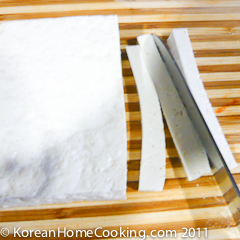
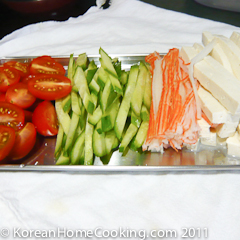
Tofu Salad-1.jpgCut tofu to about 1/4 inch thick sticks.

2.
Tofu Salad-2.jpgJulienne cucumbers and other vegetables of your choice thin and long.

3.
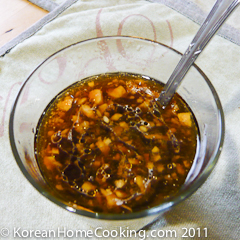
Tofu Salad-3.jpgCombine all the ingredients for sauce and shake well.

4.
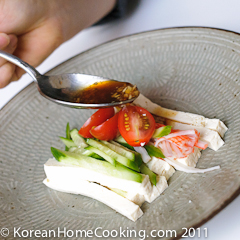
Tofu Salad-4.jpgPlace the tofu sticks at the bottom and stack all the other ingredients on top. Then pour the sauce over.

Thursday, June 9, 2011

Gosari Salad

고사리무침 [go-sa-ri-moo-chim]
This is the third in the Korean vegetable series followed by Spinach Salad and Bean Sprout Salad. While spinach and bean sprouts may be known to Westerners, gosari may still be quite foreign to many people. Gosari is the young stem of brackens which is often harvested in mountainous areas all over the world. While many cultures do not use this plant for cooking, it is commonly consumed in the Northeast Asia including Korea, Japan and China. As a matter of fact, it is also a typical ingredient in a popular mixed rice dish, bibimbap. The gosari salad in this recipe can be consumed as an independent side dish or as toppings for bibimbap.


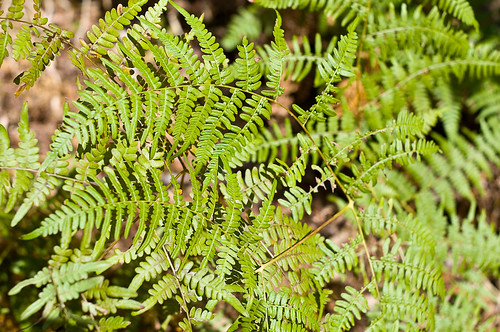
Gosari is harvested in the spring time when its stem is still young and tender.

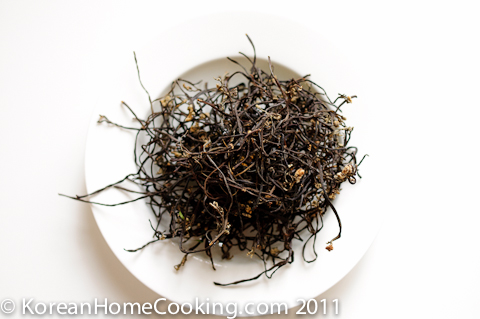
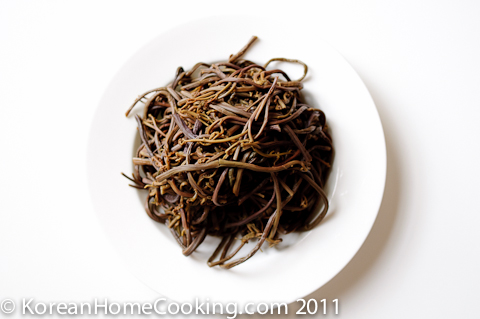
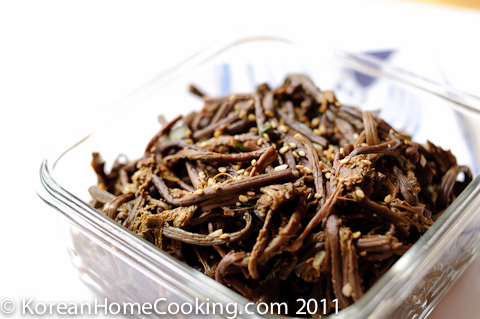
When harvested, they are boiled in water for about 5 minutes, then sun dried until they turn completely dry and dark brown as shown above for storage.


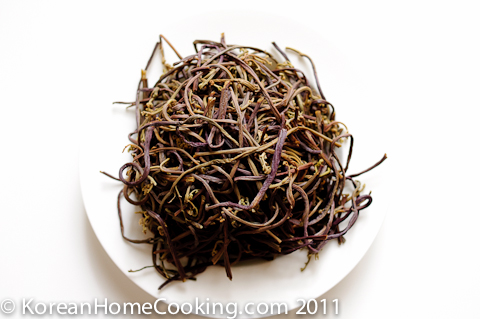
Prior to cooking, the dried gosari must be soaked in water overnight until the stems are wet and plump as shown here.


You still need to boil them in water until they turn soft like this. The volume will almost double when fully cooked and ready to be used. Depending on the quality of gosari, the cooking time could last from 10 minutes to an hour. It should be done when it's soft and you can easily chew on it.

Ingredients:

cooked gosari (300g, roughly cut in half lengthwise)
anchovy stock (1/3 cup, made of one large anchovy boiled in water for about 5 min)
olive oil (1 tbl)
sesame oil (1 tbl)
ground sesame seeds (1 tbl)

Seasoning Sauce:
Korean soy sauce (2 tbl)
garlic (1 cloves, minced)
green onion (2 tbl, chopped)
pepper (pinch)


1.
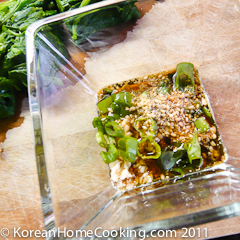
Prepare the seasoning sauce by mixing Korean soy sauce, minced garlic, chopped green onion and a pinch of ground pepper together.
2.
Season the cooked gosari in the seasoning mix in Step 1.
3.
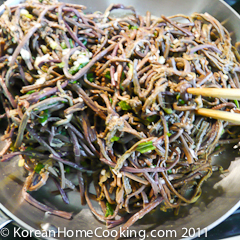
Grease the pan with olive oil and stir fry the gosari mix from Step 2.
4.
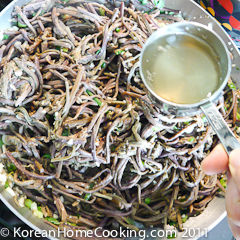
Add anchovy stock, cover the lid and simmer for about 5 minutes.
5.
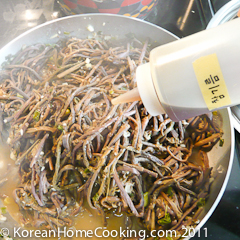
When the gosari mix is wet and moist in anchovy stock, add sesame oil and ground sesame seeds and stir fry for another minute or so.

Monday, June 6, 2011

Korean Spinach Salad

시금치무침[shi-keum-chi-moo-chim]
Spinach is packed with vital nutrients like iron and beta-carotene and is an excellent source of fiber. But unfortunately, I find there are not that many dishes that feature this healthy vegetable as main ingredient. I guess in the Western diet, spinach salad and creamy spinach are as popular as it gets. Salad is always a good option, but I personally don't like creamy spinach because creamy flavor overpowers the real flavor of spinach.

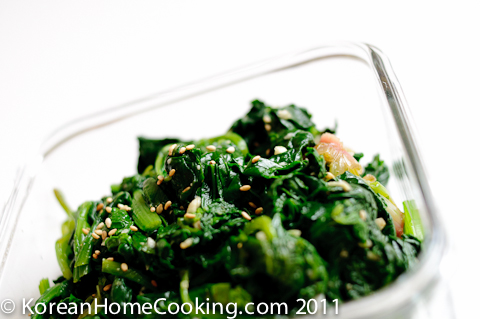
If you are looking for an alternative spinach dish, I recommend Korean Spinach Salad. Though it's called salad, we use half-cooked or blanched spinach. First, you would need a whole bunch of spinach which has stems and a little bit of roots at the bottom instead of the typical spinach leaves sold for salad. Because the spinach is only half cooked, you get the full flavor of cooked spinach while still being fresh when biting it. When it's mixed with garlic soy sauce, you would be surprised to find a wonderful combination of these two super-foods - spinach and garlic - tastes when mixed together.


Ingredients:

spinach 300g (2 bunches)
salt (1 tsp)
Korean soy sauce (1 1/2 tbl)
garlic (3 cloves, minced)
green onion (1 tbl, chopped)
sesame oil (1/2 tbl)
ground sesame seeds (1/2 tbl)


1.
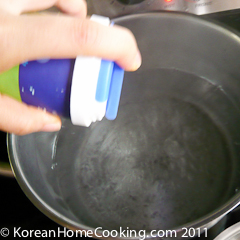
Boil water with some salt.
2.
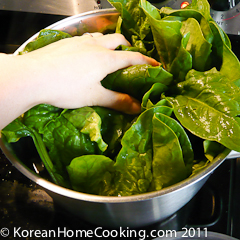
Immerse the spinach in boiling water with leafy green part on top and blanch the spinach for no more than 30 seconds. Spinach should be only half-cooked.
3.
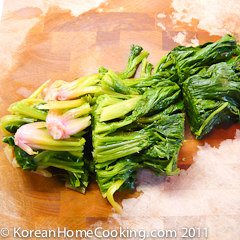
Rinse in cold water to stop cooking. Drain and squeeze out water. Then cut the spinach bunch into 3 parts.
4.
Make the seasoning sauce by mixing altogether the ingredients above.
5.
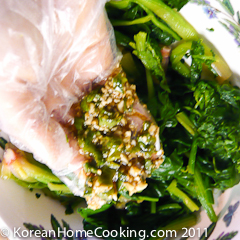
Mix the sauce into spinach.

Tuesday, May 10, 2011

Bean Sprout Salad

콩나물무침[kong-na-mool-moo-chim]
Although bulgogi and Korean BBQ are most well known Korean dishes to many Westerners, they are not part of typical Korean diet as those dishes are only served on special occasions. Contrary to popular beliefs, I think one of the defining characteristics of Korean cuisine is the use of wild and domesticated vegetables in various forms. Typical lunch or dinner table in a Korean household consists of a bowl of rice, soybean soup, kimchi, and a couple of side dishes made with various vegetables. Bean sprout salad is one of the popular side dishes.

This is a really simple recipe but there is one very important component. That is, boiling bean sprouts could be somewhat tricky because you can either have the lid closed or open but NEVER both. If you open the lid while the water is boiling and close it again, the bean sprouts would smell kinda fishy. Therefore, either not use the lid at all from the beginning, or boil the bean sprouts with the lid closed until you see the steaming coming under the lid, turn off the heat, cool off for about 5 minutes with the lid still CLOSED, then rinse the bean sprouts in cold water.


Ingredients:

bean sprouts 400g (tail trimmed)
salt (1/2 tbl)
Korean soy sauce (1 tbl)
garlic (2 cloves, minced)
green onion (2 tbl, chopped)
sesame oil (1 tbl)
chili powder (1/2 tbl)


1.
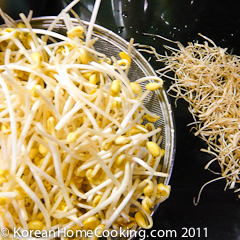
Trim the tail end of each bean sprout and wash them in water and drain. (This step is optional)
2.
Add some salt and boil the bean sprouts in cold water with lid closed until you see the steam coming off the lid. Then turn off heat and wait for another 5 minutes with the lid closed. Be sure not to open the lid in between.
3.
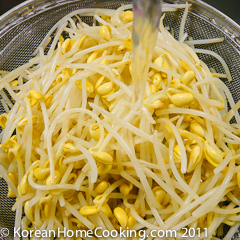
Wash the cooked bean sprouts in cold running water and drain.
4.
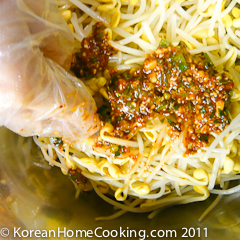
Prepare the sauce by mixing 1 tablespoon of Korean soy sauce, 2 cloves of minced garlic, 1 tablespoon of chopped green onion, 1 tablespoon of sesame oil, and half tablespoon of chili powder. If you prefer it spicy, you can add more chili powder to your liking.
5.
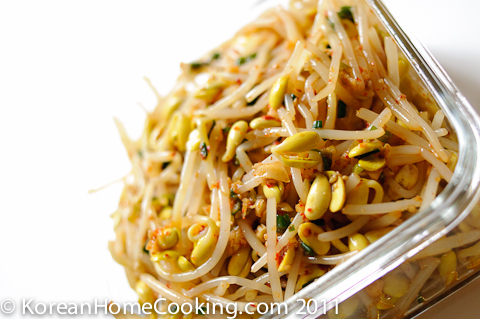
Thoroughly mix the sauce into cooked bean sprout.

Wednesday, December 8, 2010

Pickled Radish Salad


Korean BBQ is usually served with a stack of lettuce, ssamjang (thick dipping sauce), garlic slices, and some vegetable salads. It is intended for you to make a lettuce wrap with a beef slice, a slice of garlic dipped in ssamjang and some seasoned vegetable salad.

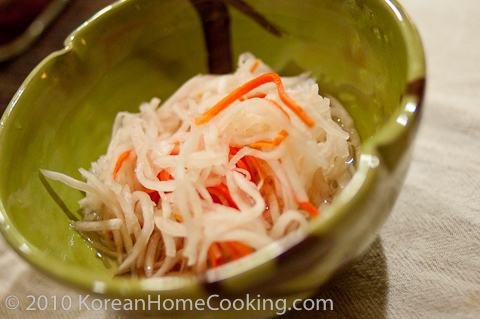
This radish salad goes very well with Korean BBQ or samgyupsal. And it can also be served as a side dish to go with your rice. Best of all, this is super easy to make and also very budget-friendly.

In this picture, my salad is poised in a beautifully hand-crafted bowl by Ms. Anna Kim which Anna gave to me as a birthday gift (Thanks, Anna!).


Ingredients for 1 serving:
daikon radish (1/2, medium size)
carrots (1/2)
water (3 cup)
vinegar (1 cup)
sugar (1 cup)
sea salt (1 tsp)

1.
It's helpful to measure out the ingredients in the ratio of water:vinegar:sugar=3:1:1.
2.
You need about half of a this, a medium size daikon radish.
3.
Stir in sugar into water and vinegar mix until they are thoroughly dissolved.
4.
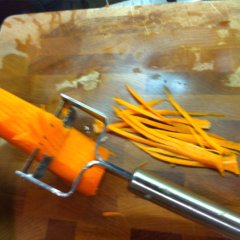
Julienne daikon radish. It's helpful to use vegetable slicer.
5.
Julienne a carrot to add some bright color to the salad.
6.
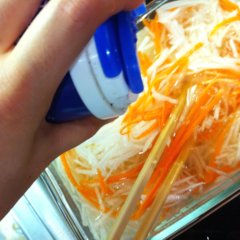
Soak the julienned daikon radish and carrots into the vinegar+sugar water. Then add a teaspoon of salt. Keep it in room temperature for overnight and then store in refrigerator.

Tuesday, December 7, 2010

Yuzu Roasted Anchovies

유자 멸치볶음[yu-ja-myul-chil-bok-eum]
Welcome back to my anchovy series. This is the third in the series followed by Spicy Roasted Anchovies and Butter Roasted Sweet Anchovies. Personally, this is my favorite.

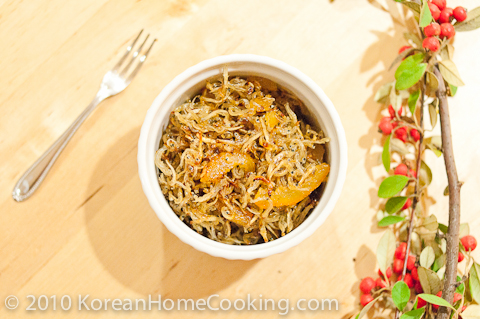
As winter approached us, I bought a jar of yuzu marmalade (yujachung) to make tea. Yuzu tea is a very popular winter time tea in Korea because it is full of Vitamin C and is widely considered as a home-remedy for cold or flu. I love yuzu’s sweet and tart flavors, so I try to use it whenever I find a chance in my recipes. Be it salad dressing or for marinating meat. These yuzu coated anchovies are quite refreshing because yuzu’s citrus smell is infused into the sweet crunchy roasted anchovies.

Ingredients:
anchovy (150g or 1 1/2 cup, the smallest anchovies called "jiri myulchi")
oil (3 tbl)
Korean yuzu marmalade (3 tbl)
sugar (1/2 tbl)

1.
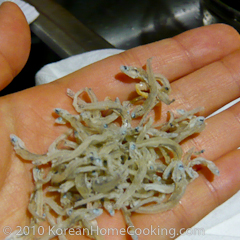
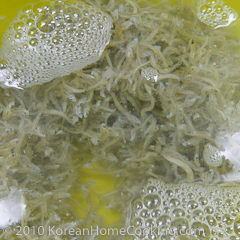
The anchovies I used here are really tiny ones. Each anchovy is probably less than a quarter of an inch tall and thinner than a thread of yarn. .
2.
Soak the anchovies in water to wash and then squeeze dry them.
3.
Spread them on a large plate and microwave for 3 minutes to dry.
4.
Over medium heat, oil a frying pan.
5.
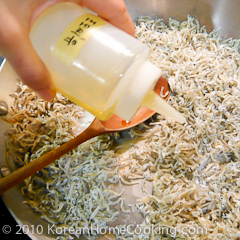
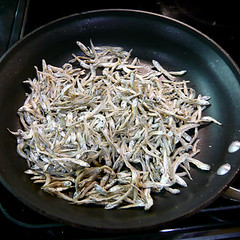
When the oil is heated, add the dry anchovies. Add a little more oil and slowly stir-fry over medium heat for about 5 minutes.
6.
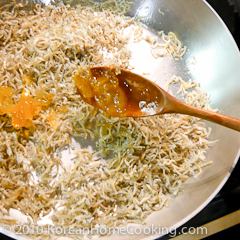
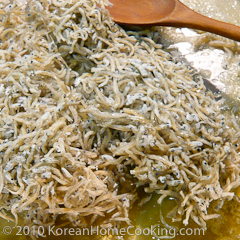
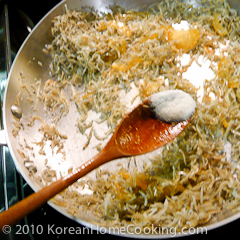
Add yuzu marmalades and keep stirring over low to medium heat for 5+ minutes until the anchovies turn golden. The longer you roast, the crunchier anchovies would get.
7.
Sprinkle sugar and quickly stir-fry for another minute.

Sunday, December 5, 2010

Butter Roasted Sweet Anchovies

버터 멸치볶음[butter-myul-chil-bok-eum]
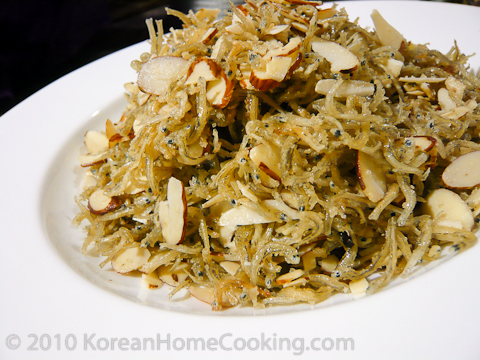
I love Korean-Western fusion dishes because they tend to bring out the best of both cuisines. This butter-roasted anchovies is a good example. I find the combination of salty anchovies roasted in sweet butter and mixed with almonds to be surprisingly delicious. They are crunch and salty, and can be quite addictive. I keep eating them as snacks even after finishing my meal.

Ingredients:
anchovy (100g, the smallest anchovies called "jiri myulchi")
sliced almond (50g)
butter (30g)
sugar (3 tbl)

1.
The anchovies I used here are really tiny ones. Each anchovy is probably less than a quarter of an inch tall and thinner than a thread of yarn. .
2.
Soak the anchovies in water to wash and then squeeze dry them.
3.
Spread them on a large plate and microwave for 3 minutes to dry.
4.
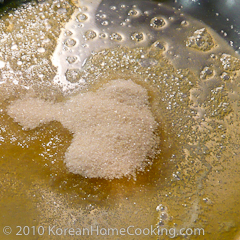
Melt the butter and sugar in a skillet over low to medium heat.
5.
Mix in the dry anchovies to butter mix and stir-fry for approximately 5 minutes. The key is to stir-fry patiently for long time over medium heat.
6.
Add sliced almonds to the anchovy mix from Step 6 and stir-fry another minute or so.

Roasted Spicy Anchovies

고추장 멸치볶음[go-choo-jang-myul-chil-bok-eum]
If you grew up in a Korean family, you would recognize this dish right away. It is a signature side dish our moms pretty much forced us to eat everyday when we were little. Or, at least my mom did. Korean moms believe that anchovies are very rich in calcium because you get to consume the whole fish including their bones. The average height of Korean people has significantly increased in the past couple decades probably due to many factors, but I am sure these anchovies played some role (with milk and other dairy products being the biggest factors). I didn’t really enjoy eating them when I was little (maybe that’s why I am not tall), but as a grown-up I really enjoy munching on these spicy and chewy anchovies to go with rice.

Ingredients:
anchovies (2 cup, medium size)
olive oil (4 tbl)

Ingredients for sauce:
chili paste (3 tbl)
olive oil (2 tbl)
garlic (1 tbl, minced)
sugar (1/2 tbl)
water (1/3 cup)
cooking wine (1 tbl)
oligo syrup/corn syrup (2 tbl)


1.
Oil the pan and stir-fry the anchovies in a dry skillet over medium heat and set them aside.
2.
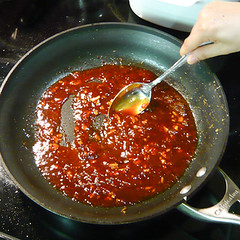
In a new skillet, mix chili paste, oil, garlic, sugar, cooking wine and water over medium heat until they are thoroughly mixed.
3.
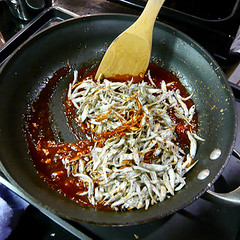
Add the roasted anchovies onto the sauce and mix thoroughly over medium heat.
4.
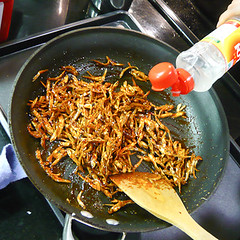
Remove from heat and glaze the mix with drops of oligo or corn syrup. Sprinkle some sesame seeds before serving.